Discover how the hustling founders of a Chilean startup with a break everything attitude sold their business of just two employees for $1Million USD.
The Beginning
QueHambre.cl’s story begins in March 2011 when three Chilean entrepreneurs (Agustín, Jaime, and Baixas) wanted to order food online instead of calling restaurants. Classic solving their own pain scenario.
So, they built a directory of 300 restaurants and launched with media coverage, getting 18,000 visits on their first day.
Growth and Challenges
The business grew slowly to about 50 orders daily, generating around 1.5 million pesos monthly ($1,500 USD). One of the biggest challenges, after convincing companies to give their system a try, was restaurants not seeing orders on time, requiring constant phone calls from their team to chase things up.
Orders came through on a screen via email and very few restaurants had the time or systems in place to be constantly watching for orders.
Being out of the day to day flow and operations of the kitchen was a big obstacle.
Gaining attention in the kitchen – Alibaba To The Rescue
Searching around a bit on Alibaba the team discovered that they could source some for around $150 dollars. With barely $1500 dollars coming in a month you can imagine what that would be like with 90 customers on the books. It was a scary investment but with a few tests the team suddenly realised that this was the game changer.
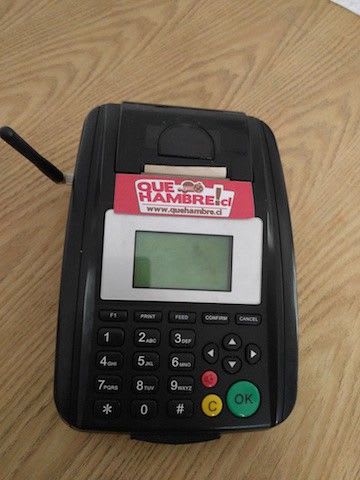
The printers weren’t cheap, were pretty ugly and Incredibly noisy. The team were really scared that this would put restaurants off, but in fact the noise of the printer was part of the winning formula. When the thing screeched and whirred, the kitchen knew that there was an order in and jumped to it.
Becoming a hardware supplier wasn’t on their software startup bingo card but hey.
With the orders now landing, the team focused on marketing
Be useful to everyone, even those that aren’t your customers
Having also taken the time to build a complete directory of every restaurant in Santiago that delivered, even those that weren’t customers, their platform was the go to spot when ordering.
The less elaborate basic listings also drove FOMO for those restaurants not in the platform, no reviews, just a button to click and reveal their phone number.
Big noise in a small room
It was about this time Felipe Ríos, a digital marketing expert, told them about Google’s new “remarketing” feature and the team jumped on it. In the weekend they took photos of Antonia (the founder’s girlfriend) and used them in remarketing ads the next week

It was a fantastic way for them to make themselves look much bigger than they were. Spending cents to show display advertising to those that had recently ordered with them, but also to those that clicked on a view phone number button in their directory, to encourage them to order online.
Nurturing their users
Together with remarketing the team also set up some fantastic segmentation of their users.
- Get hyper targeted with your nurturing – Frequent users would get special emails right at the time they would usually order.
- Be personable, switch channels. Don’t be bland and generic – When they were about to lose customers, they sent physical letters to their homes with photos of the founders, “welcoming them to the club”.
- Create a persona that others connect with – 8 hours after ordering, customers received a personal email from “Maria Jose” asking “How was the food from Pizza Piu?” with an impressive response rate. This helped collect ratings which they added to their directory.
Timing and “the last old lady in the building” strategy
With the largest directory of restaurants in Santiago and in a time of global acquisitions and consolidations, the team were in hot demand. With three suitors the negotiations went back and forth. The team knew they had some leverage. All the other online ordering platforms in Chile had already been snapped up by multinationals.
Their smart remarketing, great SEO, personalised nurturing and stance to be the most useful directory for their users, even those not using their service yet, ment they were in demand.
With all the smaller competitors acquired they were the last house on the block. They called it their “la última vieja del edificio” strategy.
What followed was many rounds of visits, pitches and negotiations. The team finally landed an offer of almost 1$M USD from the Delivery Hero.
And as Augustin says, they didn’t buy a Ferrari each, they didn’t bathe in a pool full of strawberries.
Instead they invested back into Platan.us, their parent company to do what they love most, using tech to solve problems. Their two current projects being SurBTC.com y Fintual.cl
 Nick Allen
I would love to hear your views!